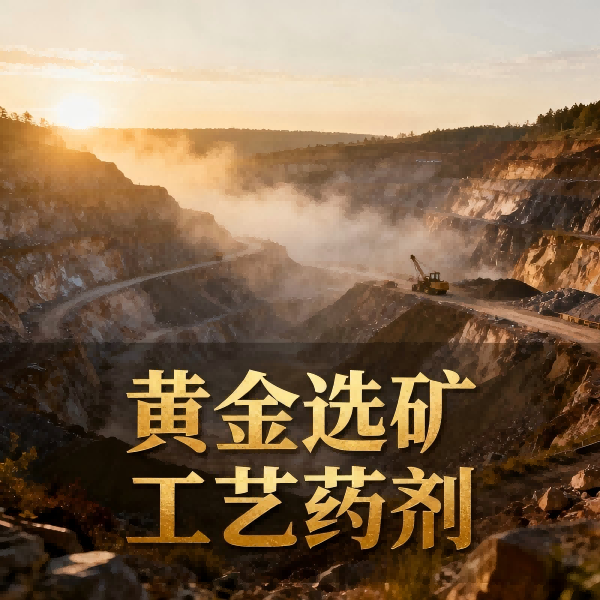
If mineral processing is compared to a relay race, then each reagent is a participant on the track. They don't come on stage at the same time, but take turns at different stages, each running their own baton well and "handing over" the gold step by step from the stone.
Today we will take a look at how these potions "relay" on site.
When the ore is transported from the mine, it is a piece of stone that needs to be ground into fine powder first. Don't underestimate this grinding process - some chemicals have already started working at this point.
For ores with complex compositions, such as gold and arsenide mixed together, engineers will add some "adjusting agents" during grinding.
These agents will pre adsorb on the surface of mineral particles and perform "pretreatment" on arsenic compounds. Simply put, it means holding them down in advance to prevent them from causing trouble in the subsequent flotation process - things that should not float up should not be given a chance from the beginning.
The commonly used types of chemicals include sodium carbonate, zinc sulfate, etc., and their combination ratios need to be determined according to the specific conditions of the ore. Once this step lays a solid foundation, the subsequent work will be much smoother.
The ground mineral powder is made into a slurry and enters the flotation tank. At this moment, the collector and foaming agent appeared.
The task of a collector is to "dress" the surface of gold containing mineral particles - making them go from liking to stay in water to being willing to lean towards bubbles. Different collectors have different "personalities": some are gentle, some are strong. For easily floatable ores, using mild ones is sufficient; For difficult to select ores, it is necessary to use strong ones, and sometimes it is necessary to combine strong and gentle ones to achieve better results than using one alone.
The task of a foaming agent is to create bubbles. Without bubbles, mineral particles wearing swimsuits cannot float to the surface of the water. The foaming agent makes the bubbles thin, numerous, and stable, acting as a "transportation tool".
When these two agents are well matched, the gold bearing minerals will attach to the bubbles, float to the pulp surface calmly, and be scraped away by the scraper, forming "concentrate foam".
The purity of the "concentrate" produced in the first round of flotation may not be high enough - it may contain some impurities that should not have been added. At this point, it is necessary to enter the selection stage.
In the selection stage, inhibitors will be added. The function of inhibitors is exactly opposite to that of collectors - they prevent certain minerals from floating up. For example, lime can inhibit pyrite; Water glass can inhibit vein minerals such as quartz and silicate. By adding inhibitors, the impurities mixed in the concentrate will be "pushed" back into the slurry, and the purity of the foam left on the water surface will become higher and higher.
After one or even multiple rounds of selection, the final grade of the gold concentrate reaches the qualified standard and can be sent for smelting.
In the flotation process, the pulp left after the first scraping of foam is called "tailings". There may still be some gold in the tailings that hasn't floated up yet, especially those that are tightly wrapped by other minerals.
At this point, the activator comes in handy. The function of activators is to "awaken" the encapsulated minerals - to "peel off" or "wash off" the surface coating, allowing the capture agent to adsorb again.
The most commonly used activator is copper sulfate. After adding an activator, the previously "silent" mineral was activated, and with another capture using a collector, a portion of the gold could be recovered. This is what is commonly known as "sweeping" in mineral processing - retrieving the gold that was missed in the first round.
For some gold that is particularly fine or has poor flotation performance, there is another way - leaching method.
The leaching method does not require flotation, but directly sprays a reagent solution that can dissolve gold onto the ore. During the infiltration process of the medicine, the gold is dissolved in water, and then the gold containing solution is collected. Activated carbon or zinc powder is used to "grab" the gold from the water.
Traditionally, the most commonly used is sodium cyanide, which has good gold leaching effect and low cost, but it is a highly toxic chemical with strict regulations on transportation, storage, and use. In recent years, environmentally friendly mineral processing agents are gradually replacing it. Environmentally friendly chemicals retain the gold leaching ability of sodium cyanide, but significantly reduce toxicity - safer transportation and storage, and simpler tailings disposal.
The entire beneficiation process is like a relay race, where the timing, order, and amount of reagents added in each step will affect the final effect.
If added too early, the medicine may be consumed by other minerals, and when it's your turn to take effect, you may lose strength.
Added too late, missed the best window period, and the gold has already gone to the wrong place.
The dosage is too small and the effect is not enough; Excessive usage not only wastes, but may also have a counterproductive effect.
The job of a beneficiation engineer is to find the most suitable "reagent system" based on the characteristics of each ore - which reagent to use, when to add it, how much to add, who to add first and who to add later. This is both a science and an experiential activity.
From grinding to flotation, from selection to sweeping, from leaching to tailings treatment, each reagent plays a crucial role in its own 'stick'. Some of them are responsible for "wearing swimsuits", some are responsible for "blowing bubbles", some are responsible for "removing impurities", some are responsible for "awakening the sleeper", and some are responsible for "dissolving". Only by performing their respective duties, appearing on time, and cooperating seamlessly can gold be efficiently "invited" out of the stone.
 中文
中文 fra
fra spa
spa it
it alb
alb en
en de
de nl
nl ru
ru bel
bel jp
jp cht
cht kor
kor