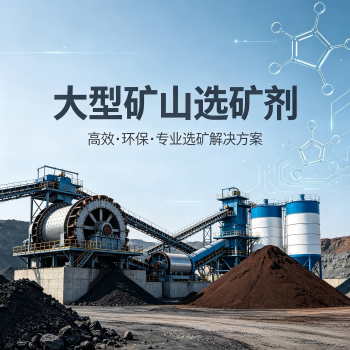
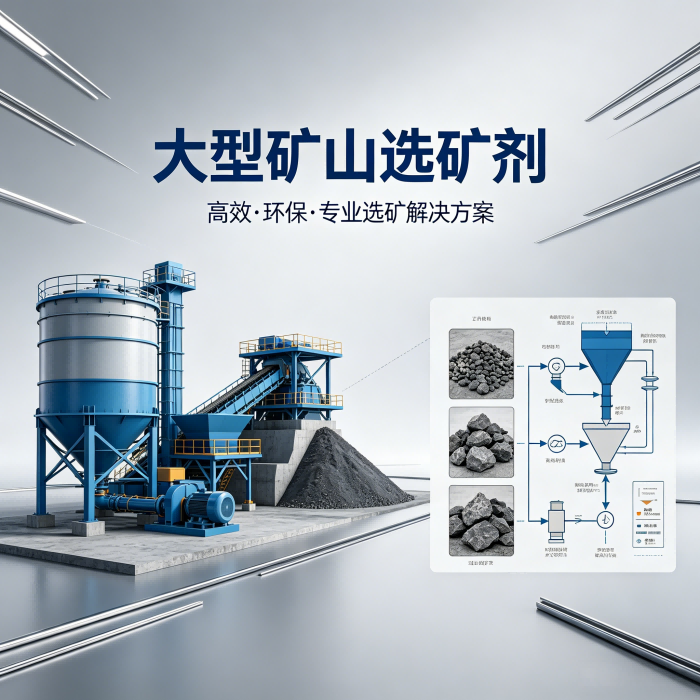
Mineral processing in small mines, like cooking in small restaurants - there are only a few seasonings, and no matter how you make them, they always have those few flavors. Large scale mining beneficiation is like the kitchen of a top restaurant - the ingredients are complex and the craftsmanship is exquisite. Each seasoning needs to be carefully selected and flexibly adjusted according to the situation of the ingredients on the day.
Today we will talk about the differences between selecting and using mineral processing agents in large mines and ordinary mines.
Large mines process a huge amount of ore every day and rely much more on chemicals than small mines. At the same time, it also faces several special challenges.
The ore properties are unstable.
The mining life of a large mine may span many years. As the mining depth changes, the properties of the ore are also gradually changing - today we are digging this type of ore, but in a while it may be another type. If the medication plan remains unchanged, the effect will fluctuate.
Impurity interference is more complex.
The ores of large mines often contain multiple metallic elements. For example, lead-zinc mines may contain multiple components such as copper, silver, and sulfur simultaneously. If you want to recycle more of this metal, that metal may run away. Engineers often say 'press the gourd to float the ladle', which means this.
Environmental pressure is greater.
The larger the scale, the greater the amount of tailings and wastewater. The risks and costs of using traditional highly toxic pesticides in large mines have been magnified. Once a problem arises, it is not a small-scale, but a large-scale environmental event.
In the past, many mines used to use "universal formulas" when selecting chemicals - if a certain chemical is well-known and widely used in the industry, then buy it. This approach may be feasible in small-scale mines, but it is not feasible in large-scale mines.
The practice of large-scale mines is to "tailor to the mine": first, conduct a detailed "physical examination" of their own ore - analyze its composition, structure, and the embedding relationship of various metals, and then select and prepare reagents based on these data.
Taking a large lead-zinc mine as an example. They spent a considerable amount of time developing a new collector system, while keeping the existing flotation equipment and processes unchanged. By adjusting the ratio and addition method of the reagents, not only did the recovery rate of the main metals improve, but also the germanium metal associated with the ore was easily recovered. This is the value of "adapting to the mine" - not changing the medicine, but designing a complete set of "prescriptions" to "squeeze out" the value in the ore.
The chemical system of large mines often involves the coordinated operation of multiple chemicals. Taking a lead-zinc mine with a long history of mining as an example, the ore properties are extremely complex - useful minerals are finely embedded, closely associated with pyrite, and the grade of associated metals is extremely low. Faced with such 'hard bones', they collaborated with research institutes and spent a long time tackling them.
The final solution is a multi-stage coordinated process: first, develop a highly selective collector specifically for capturing lead and silver; Using new technologies to achieve green separation of copper and lead; Finally, mechanical activation technology is used to recover pyrite. With this combination of punches, the lead recovery rate and zinc recovery rate have reached a high level, achieving efficient recovery of associated copper and sulfur resources, and the tailings wastewater has also been recycled.
For large mines, the "ease of use" of chemicals is certainly important, but "stability" may be more crucial.
The reason is simple: the production of large mines operates continuously, stopping today and starting tomorrow, resulting in huge losses. If one batch of reagents has good effects and the next batch has poor effects, the mineral processing indicators will fluctuate like a roller coaster, and the entire production system will have to adjust accordingly.
Therefore, when selecting pharmaceutical suppliers, large mines attach great importance to "batch stability" - the composition, purity, and performance of each batch of goods must be highly consistent. Some large mines even require suppliers to provide detailed quality inspection reports for each batch of products and conduct self sampling and re inspection.
This is also why some pharmaceutical manufacturers with independent purification technology and digital production control systems are more favored by large mines. They can control the product indicators within a very narrow range, ensuring that 'this batch is no different from the previous batch when used'.
In large mines, the use of adjusters is a delicate activity. Unlike collectors, adjusters do not directly "grab" gold. They are responsible for adjusting the flotation environment - pH, ion composition, particle state, etc.
Taking pH adjusters as an example, the most commonly used are lime and sodium carbonate. Lime is cheap and effective, but adding too much may inhibit the upward movement of certain useful minerals; Sodium carbonate has weaker alkalinity and is more friendly to certain minerals. Which one to choose and how much to add depends on the properties of the ore on that day.
There are also inhibitors and activators - one responsible for "holding down" those who should not come up, and the other responsible for "waking up" those who are asleep. In the face of complex ores in large mines, the combination of these two agents is like a precise deployment of troops.
Large mines produce a huge amount of slurry every day, and if the fine particles in the slurry settle naturally, it takes a long time and a large area of land. At this point, flocculants are needed to help - they can cause small particles to "clump together" and become larger particles to accelerate sedimentation.
But the use of coagulants also requires attention to detail. Insufficient use leads to poor settlement effect; If used too much, there may be "anti flocculation" - the flocs may actually disperse. Moreover, different types of coagulants are suitable for different ores and water quality. Some are suitable for anionic types, while others are suitable for cationic types, and the optimal solution needs to be determined through experiments.
With the tightening of environmental policies, large mines are accelerating the transition from traditional highly toxic chemicals to environmentally friendly chemicals.
For large mines, the priority of "safety" and "compliance" is often higher than "affordability". The use of environmentally friendly chemicals may have a slightly higher unit price on the surface, but it saves the management cost, security cost, and harmless treatment cost of highly toxic chemicals, and overall it is not a loss. More importantly, it helps businesses avoid significant environmental and safety risks.
Overall, there are several principles worth paying attention to when selecting and using beneficiation agents in large mines.
Adapt to mining conditions rather than following trends.
Other people's "miracle drugs" may not necessarily be suitable for your ore. First, thoroughly study your own ore, and then design and select a chemical solution.
Focus on overall cost rather than unit price.
Cheap medication does not necessarily save money, expensive medication does not necessarily cost money. We need to include management costs, safety costs, and environmental protection costs.
Value the service capabilities of suppliers.
What large mines need is not "medicine sellers", but partners who can provide ore testing, customized solutions, on-site debugging, and continuous optimization.
Maintain dynamic optimization of the pharmaceutical system.
The properties of the ore are changing, and the chemical scheme should also change accordingly. Regular evaluation and continuous optimization are mandatory courses for large mines.
The use of mineral processing agents in large mines is becoming increasingly refined and customized, from universal formulas to tailored to the specific needs of each mine. The selection of each agent is based on a deep understanding of the characteristics of the ore; Every adjustment of the formula is driven by the relentless pursuit of "eating dry and squeezing clean". This is not only the competitiveness of large mines, but also the development direction of the entire mineral processing industry.
 中文
中文 fra
fra spa
spa it
it alb
alb en
en de
de nl
nl ru
ru bel
bel jp
jp cht
cht kor
kor