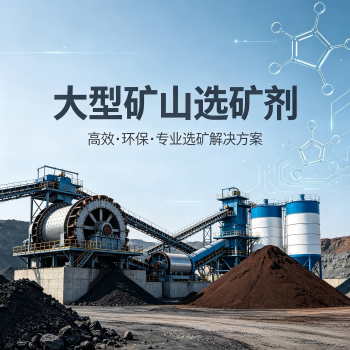
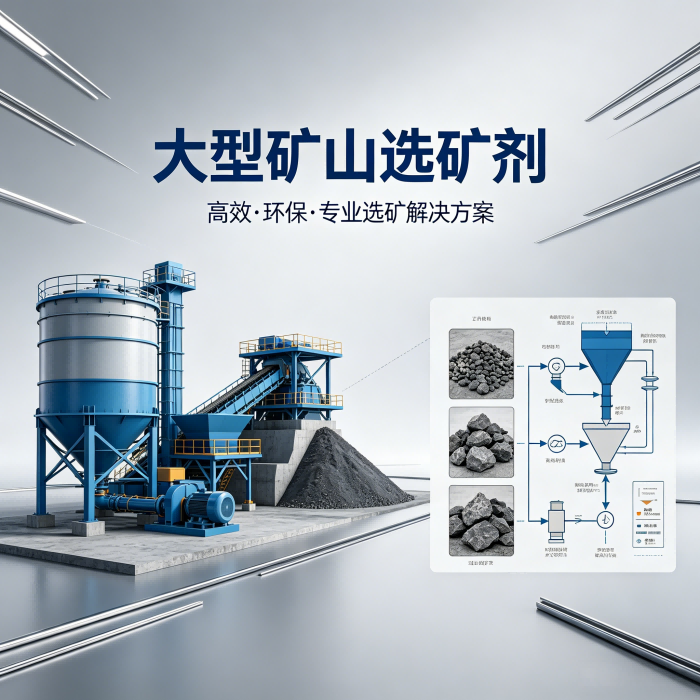
In the field of gold beneficiation, in addition to the common flotation and agitation leaching methods, there is also a low-cost and widely used method——Heap leachingIt is like a huge 'drip coffee machine', slowly spraying a solution of medicine onto a pile of ore, collecting the flowing rich gold solution, and ultimately extracting gold.
This method is particularly suitable for handlingLow grade gold mineTailings with a grade of 0.5-1.5g/t or previously considered as "waste rock". Today, we will start from the principle of heap leaching process and deeply analyze the key role played by environmentally friendly chemicals in it.
Heap leaching is a metallurgical process for recovering gold from low-grade ores. The basic process is as follows:
Build a pileTransport the crushed ore to the appropriate particle size onto the anti-seepage cushion and build it into a huge heap (usually 3-10 meters high).
spraySpray the leaching agent solution evenly on the surface of the ore heap through drip irrigation or spraying system.
infiltrationDuring the process of infiltration through the ore heap, the leaching agent undergoes a chemical reaction with precious metals such as gold and silver in the ore, dissolving them.
collectA solution rich in precious metals (precious liquid) flows out from the bottom of the pile and is collected in the precious liquid pool through a collection ditch.
recycleUsing methods such as activated carbon adsorption and zinc powder displacement to recover gold from precious liquid; The depleted liquid after gold removal is re dispensed and reused.
Advantages of heap leachingThe process flow is simple, the investment is low, the effect is fast, and the production cost is low, especially suitable for large-scale processing of low-grade ores, which can turn a large amount of resources that were originally economically unmineable into treasures.
In heap leaching process, leaching agent is the core that determines success or failure. In the past, sodium cyanide was the absolute protagonist; Nowadays, environmentally friendly mineral processing agents are rapidly penetrating this field with their unique technological advantages.
Key points of application of environmentally friendly beneficiation agents in heap leaching:
Spray concentration control
Compared with traditional sodium cyanide, environmentally friendly agents usually require adjusting the initial spray concentration in heap leaching. According to production practice, when using environmentally friendly agents for heap leaching, the initial concentration can be slightly higher than that of sodium cyanide (such as 0.08% -0.12%). After the gold content in the precious solution stabilizes and increases, the concentration of the supplement can be gradually reduced. This strategy of "first concentrate and then dilute" can ensure rapid dissolution of gold in the early stage and avoid wastage of reagents.
PH value management
Environmental protection agents have the best gold leaching effect under alkaline conditions (pH 10-11). Therefore, it is usually necessary to add lime or sodium hydroxide to adjust the pH value of the slurry. It should be noted that in some mining areas, the use of lime with high magnesium content may produce flocculent sediment, which can clog the sprinkler pipes. The solution is to switch to on-site digestion with quicklime or use it in conjunction with a small amount of dispersant.
Penetration optimization
The heap leaching process requires the leaching agent to penetrate the entire ore heap uniformly and rapidly. If the content of fine mud in the ore is high, it is easy to cause "compaction", leading to the flow of reagents and a decrease in leaching rate. At this point, an appropriate amount of penetrant or flocculant (such as polyacrylamide) can be added to improve the permeability of the ore heap.
Circulating fluid management
Similar to the sodium cyanide system, the heap leaching of environmentally friendly chemicals also adopts a cyclic spray mode. As the number of cycles increases, impurity ions (such as iron, copper, arsenic, etc.) will accumulate in the solution, affecting the leaching efficiency. At this point, it is necessary to regularly open the circuit, discharge some of the lean solution, and replenish fresh water and chemicals.
Practical Case ReferenceA certain gold mine originally used sodium cyanide heap leaching, but later switched directly to environmentally friendly beneficiation agents without changing any process equipment. The initial concentration is controlled at 0.1%, and the spraying cycle is 45 days. The results showed that the gold leaching rate reached 88.6%, which was basically the same as the 89.2% of sodium cyanide; The tailings are classified as low toxicity solid waste after testing, and do not require harmless treatment. This alone saves over 2 million yuan in environmental protection expenses annually.
In actual production, the choice between heap leaching or agitation leaching depends on the properties of the ore and project conditions.
| comparative dimension | Heap leaching | Stir leaching |
|---|---|---|
| Applicable grade | Low grade (0.5-1.5g/t) | Medium or above (>3g/t) |
| investment cost | Low, no need for large grinding equipment | High, requiring crushing, grinding, mixing tank, etc |
| production cycle | Long, single batch 30-90 days | Short, single batch 24-72 hours |
| leaching rate | Relatively low (60% -80%) | High (85% -95%) |
| Applicable scenarios | Low grade ore and tailings reuse | High grade concentrate, easily processed ore |
A popular analogyMixing and leaching is like washing clothes in a washing machine - fast and efficient, but with limited processing capacity at once; Heap soaking is like spreading clothes in a field and slowly pouring rainwater - slow work produces fine work, but it can also process a "large area" of extremely low-grade resources at the same time.
Although heap leaching technology is economically convenient, it also faces some environmental challenges, and environmentally friendly chemicals provide a solution.
Pain point one: anti-seepage problem
Once the heap leaching pad is damaged, the solution containing leaching agent may seep into groundwater. Using low toxicity environmentally friendly agents, even in the event of accidental leakage, the environmental risks and subsequent repair costs are much lower than those of sodium cyanide.
Pain point 2: Tailings disposal
After heap leaching, residual chemicals in the mine heap may continue to leach with rainwater. The tailings leached with environmentally friendly agents are usually classified as low toxicity or general solid waste after testing, and do not require expensive neutralization and cyanide breaking treatment like cyanide residue. They can be directly used for ecological restoration.
Pain point three: Water resource consumption
The heap leaching process requires a large amount of water, especially in arid areas. The environmental protection agent system is well compatible with the closed-loop water system, minimizing the amount of fresh water replenishment and wastewater discharge.
Refinement of pharmaceuticalsDevelop specialized environmental protection agents for different types of ores, such as high arsenic ore, high carbon ore, high copper ore, etc., to achieve "one mine, one policy".
Process intelligenceReal time monitoring of parameters such as gold content, pH value, and drug concentration in precious liquid through online sensors, automatic adjustment of spray and replenishment amount, achieving precise control.
Whole life cycle managementProvide an integrated solution from ore heap construction, chemical spraying to tailings remediation, integrating "green" throughout the entire heap leaching process.
The heap leaching process may seem simple, but it actually contains the engineering wisdom of "using softness to overcome hardness". It has transformed countless low-grade gold mines from "waste rock" to "treasure", opening up new resource boundaries for the gold mining industry. The integration of environmentally friendly beneficiation agents further enhances the "green background" of this process - retaining the economic benefits of heap leaching while eliminating the safety hazards of highly toxic chemicals. For enterprises aspiring to pursue the path of green mining, understanding heap leaching and using environmentally friendly chemicals effectively are essential courses that cannot be ignored.
 中文
中文 fra
fra spa
spa it
it alb
alb en
en de
de nl
nl ru
ru bel
bel jp
jp cht
cht kor
kor